The body of this post is lifted from my little WeChat public account — I never expected anyone else to actually see it. My WeChat account is its own private little plot of land for me; every so often at some inflection point I’ll suddenly want to start tapping out words, and I’ll open the back-end of the account.
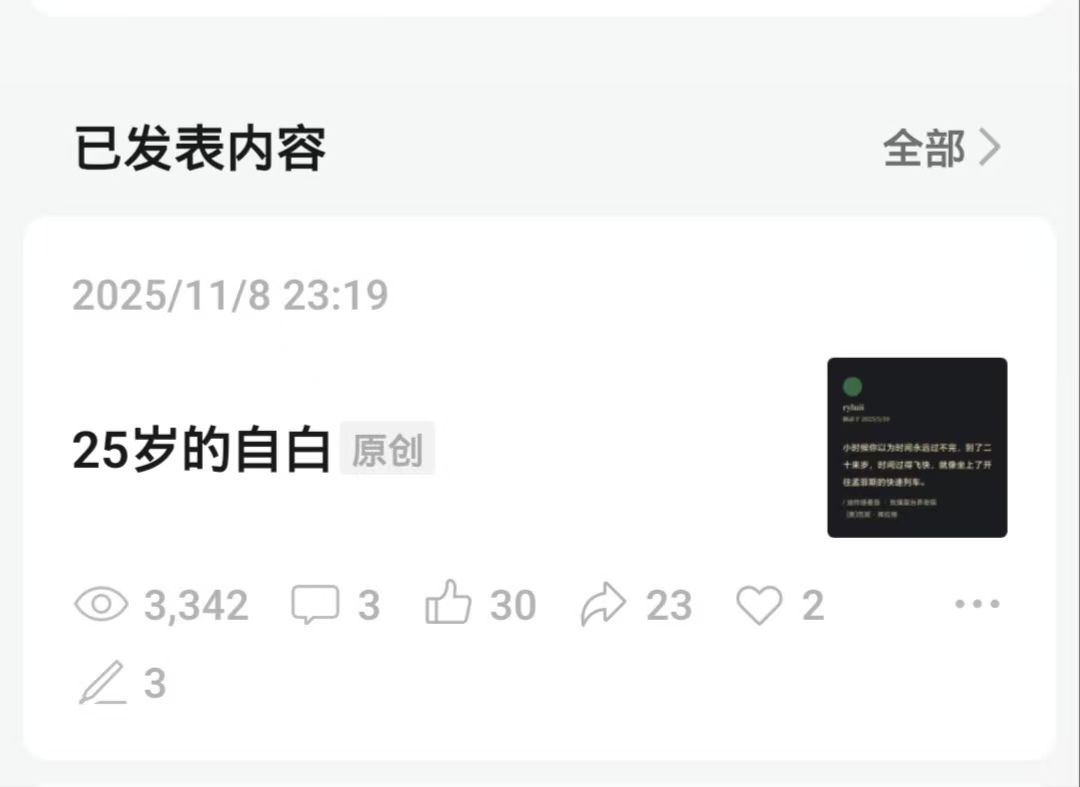
(26/04/25 — Suddenly remembered I also have a blog. The domain costs ten US dollars a year. So I leeched off Cloudflare — the cyber bodhisattva — set up an image hosting service, and now I’m uploading images with PicGo :) Wrestled with the S3 plugin for ages on failed uploads, even though it should be a simple thing :D)
I don’t know how to put it — I’m genuinely afraid of being seen, of being found out, of having other people pay attention to me. I’ve pretty much always lived inside my own world. Even building a website or running the public account — those are just parts of what’s in my head, written down. I don’t care about view counts or follower numbers; it’s only a record of my life. More than fear of failure, I have a fear of success. I just want to be a dull, lightless stone, ash-gray and unremarkable, living plainly.
In college I spent ages writing news copy for the school’s publicity department — it’s been so long now I’d almost forgotten that, at one point, I actually liked writing. I wrote a short story and submitted it somewhere. Then I transferred majors and got buried in catching up on credits. I don’t even know how I got through those painful days. By the time I came up for air, all of it had already passed — and what had vanished along the way was my passion and drive for writing. My numbness came too early. My anxiety came too early.
Time really does smooth over everything. The stretch I once thought was unbearable, that I-can’t-live-like-this stretch, has somehow already faded from memory by seventy-something percent. The first major crisis of my life arrived at 19. At 20 I was still living with the after-shocks. I still remember the senior who jumped from the fifth-floor men’s bathroom of Teaching Building One in May of 2021. We didn’t know his name, and we didn’t grieve excessively — we just felt a quiet sorrow over it. The next day the Earth was still spinning, with one less person on it.
Maturing early is also a way of maturing late. After going through a mental crisis too early, I think I shut myself away in a corner where only I was allowed, built an invisible fence around myself, and didn’t let anyone get near. Sometimes I wonder if I’m still 19. But when I try to remember that year, there isn’t much left in my head — my brain made the choice for me. A friend and I were talking, and we said: we actually went through some kind of trauma that’s hard to name. From the outside it might look like we were being precious about it, but a gale ripped through, and only we know how torn up the inside is — to the point where we started questioning the possibility of going on living.
Life is suffering, but you still have to live. That’s the line that stuck with me most from Tokyo’s Impoverished Women.
What follows is the actual post:
1. Some Memories
The first morning of waking up at 25, the sun was so bright it was almost painful, and for a moment I thought the world was fake. The whole year of being 24 felt like a giant hallucination, no sense of weight to it, as if I’d blinked once and opened my eyes again at 25.
My family doesn’t actually have a tradition of celebrating birthdays. Strangely, every time my birthday rolls around I think of my grandpa. He’s been gone 13 years now, and he rarely comes to my dreams. Night after night I have all kinds of bizarre, kaleidoscopic dreams, and he’s never in them. In 2012, my grandpa turned 80 — a beautiful summer — and the family threw him a birthday banquet, wishing he could stay with us a while longer. That winter the weather was unusually cold. From the sudden stroke to his death, it was only a week.
I can still picture that afternoon. Northern winter sunlight at that hour falls especially warm on the body. The light tilted in through the window glass and pooled across the floor in dappled patches, sometimes catching a person, a face, like we were bathing in it. My mom and grandma and I were all by my grandpa’s side. I watched his chest rise and fall more and more faintly, his expression growing peaceful. It was the second time I’d experienced the death of someone close. I was 12. On a bright winter afternoon, for the first time, I saw that death was actually this calm. The sunset that day was an especially deep red. It was only when I got home, washing my face, that I burst out crying — I’d never see Grandpa again, my mom no longer had a dad. Sometimes even grief arrives late.
Maybe this is a kind of curse. The next summer, 2013, my Third Granduncle and Third Grandaunt went to Yulin for a birthday banquet hosted by her family. On the highway home there was a serious car accident, and they didn’t make it back. Two people in the car died; my grandaunt and the driver, also a relative, survived. But the ones who survive have it harder — they live carrying pain and guilt forever. There’s this kind of senseless misfortune in the world that leaves you with no one to direct your bitterness at. They had been a blended family, and after the accident it just thinned out and scattered. My Third Grandaunt went to Xinjiang alone for work. When I finally saw her again much later, she carried a kind of dusk around her — her hair was streaked with white, and a faint, unidentifiable sadness moved through her face. As a child during Spring Festival I’d dart over to their place all the time. Their house was always full of relatives and guests, a warm and lively place. I loved my grandaunt’s perfectly calibrated warmth and sincerity. All of that disappeared with my granduncle. My grandaunt is still herself, still good, but she doesn’t look happy. She no longer laughs out loud. So much of what mattered is missing.
2. Some Reflections
After that, nobody in our family ever brought up celebrating someone’s birthday again — some unspoken pact had formed. I inherited that part. Except in college, when I got close with my first-year roommates and we agreed to celebrate each other’s birthdays, I basically don’t have a concept of birthdays.
Why write about deaths in the family on my birthday? Because I’m slowly starting to feel that life is really just a process of continuous loss. You keep losing important people; you walk a different road from a lot of others and you gradually drift apart, until in the end it’s really just you alone. This year has had a lot of changes and unexpected events — things involving my family, my roommate, the cat that some friends and I rescued. The accidents come fast and you can’t catch your footing. One night the cumulative impact felt too much and the insomnia kicked in. These feelings really can’t be spoken out loud, can’t be described with words. Growing up just is like this — no one cares about us, we have to digest these things on our own, solve and process everything ourselves.
In September last year I started a tracking journal — bought a notebook for it, and surprisingly it’s one of the few things I’ve actually kept up this year. I record each day’s highlight, track habits, set monthly goals. When I feel anxious on some particular day, I sit down and write, and drain out all the negative feeling. I’m close to filling up the whole notebook now. I hope to leave some mark on every day I’m living through.
At the start of the year I wrote out yearly goals for myself in Google Docs. I just opened the doc — not one of them is done. My brain is still flat, my wallet is still flat, and the promised hiking trip never happened because I’m scared of snakes. But somehow I don’t feel devastated about it. I feel calm. My reading progress for the year is 39/48. Books really are an excellent shelter — every time I’m reading I feel safe. Even though my attention only lasts three minutes and I never read much on any given day, the accumulation is unambiguously good for building inner order. I’m learning to stop regretting the past so much. Maybe that really was the best choice the person back then could have made.
Every year living through some things gives me a few small takeaways. This year, the biggest one: build your inner order as early as possible. Get out of other people’s evaluation systems, out of the obsessive accounting over what society will or won’t reward you with. Throw yourself in fully. Also: do not put all your eggs in one basket — that kind of system has terrible risk tolerance and is far too fragile. And: a lot of things will not unfold along the path we’d hoped. Either adapt to the environment, or cut your losses and jump out in time.
After only two short years of working, I can feel my brain getting duller, and some of my memories are quietly going away. Sometimes I wonder what I’ll even have left to hold onto down the road.
Anyway, just enjoy this journey — it’s all about the experience, not the destination.